OPAL Psychological | La Jolla, San Diego
Relationship & Communication Challenges? Therapy for Men in San Diego
When Communication Feels Hard, Connection Can Feel Even Harder.
Relationships can be meaningful and complicated. If you’ve been struggling to express yourself, navigate disagreements, or feel understood, individual therapy may offer a place to explore what’s happening.

Does Any of This Sound Familiar?
Communication difficulties look different in different relationships. Here are a few ways they can feel.
You Feel Misunderstood
You try to explain yourself, but the conversation doesn’t seem to go the way you hoped.
You Shut Down During Conflict
When conversations become intense, you may find yourself going quiet or pulling away.
You Become Defensive
Even a small disagreement can begin to feel like criticism.
The Same Arguments Keep Happening
Different conversations seem to lead back to the same unresolved issues.
It’s Hard to Express What You Need
You may know something feels wrong but struggle to put it into words.
You Feel Disconnected
You care about someone but aren’t sure how to rebuild understanding or closeness.
These experiences are not unique to men and do not, by themselves, indicate a mental health diagnosis. This isn’t a checklist or an assessment.
Why Is It Sometimes So Hard to Say What You Mean?
There usually isn’t a single reason. Communication is shaped by many things at once, and what’s true for one person or one relationship may not be true for another.
The items on this list are possible influences, not universal causes. Being a man doesn’t make someone a poor communicator, and communication is always a two-way process involving everyone in the conversation.
- Things that can play a role
- Stress
- Emotional overwhelm
- Past relationship experiences
- Learned communication patterns
- Fear of conflict
- Difficulty identifying emotions
- Different expectations
- Unresolved disagreements
- Life transitions
- Competing responsibilities
Understanding the Patterns That Keep Showing Up
Patterns like these are common in relationships of all kinds. None of them is automatically unhealthy, none is anyone’s fault alone, and naming them isn’t the same as labeling a person.
Withdrawing During Conflict
When a conversation starts to feel like too much, some people pull away, go quiet, or leave the room. It can be a way of trying to cool things down, but to the other person it can look like distance.
Becoming Defensive
Criticism, or what feels like criticism, can set off a protective reaction. Explaining, justifying, or pushing back can come quickly, before there’s time to take in what the other person meant.
Avoiding Difficult Conversations
Putting a hard topic off can bring short-term relief. Over time, the issue often stays unresolved and can add tension of its own.
Repeating Unproductive Arguments
Interaction patterns can become self-reinforcing, with each person’s reaction feeding the other’s. They can be hard to change without some reflection and new approaches.
Difficulty Expressing Needs
Recognizing what you need, and then putting it into words, can take practice, especially if it wasn’t modeled or encouraged earlier in life.
Understanding What You Feel Can Change How You Communicate.
Emotional awareness and communication are closely linked. This simple sequence is an educational way to picture it. It isn’t a clinical protocol, and real life rarely moves in a straight line.
Notice
Recognize emotions and your own stress responses as they show up.
Understand
Get curious about triggers and what might sit underneath a reaction.
Communicate
Express needs and set boundaries, and listen with curiosity.
Reflect
Look back on what happened and recognize recurring patterns.
- Recognizing emotions
- Identifying stress responses
- Understanding personal triggers
- Reflecting before reacting
- Communicating needs
- Setting boundaries
- Listening with curiosity
- Recognizing recurring patterns
These are skills that can be explored in individual therapy. Progress varies from person to person, and no particular improvement can be guaranteed.
You Don’t Have to Be in Couples Therapy to Explore Relationship Challenges.
Individual therapy focuses on the person receiving treatment. It can offer room to look at your own emotional responses, habits, and expectations in relationships, whether or not anyone else is in the room.
It isn’t a substitute for couples therapy when joint treatment is indicated. This page is about individual therapy, and a clinician can help talk through which kind of support fits a given situation.
- Individual therapy can make space for
- Personal emotional responses
- Communication habits
- Relationship expectations
- Conflict patterns
- Boundaries
- Stress
- Personal values
- Attachment experiences, when clinically appropriate
- Relationship-related anxiety
- Life transitions
Creating Space for More Meaningful Conversations
Therapy goals are individualized. These are some areas people may choose to explore. They aren’t promises about how a relationship will turn out.
Understanding emotional responses
Get a clearer sense of what you feel, when, and what tends to set it off.
Recognizing unhelpful patterns
Notice communication habits that aren’t serving you, without blaming yourself or anyone else.
Expressing thoughts and needs
Practice putting what matters to you into words more clearly.
Navigating disagreements
Explore different ways of staying in a hard conversation and responding to it.
Exploring boundaries and expectations
Think through what you’re comfortable with, what you expect, and where those differ from others’.
Building greater self-awareness
Develop a fuller picture of your own patterns, values, and responses over time.
You Don’t Have to Wait for a Relationship Crisis.
People consider individual therapy for many reasons, and there’s no single threshold. Here are some situations in which someone might reach out. You don’t need to recognize yourself in any particular one.
If a relationship feels unsafe, please read When a Relationship Feels Unsafe below.
- Some reasons people reach out
- Communication difficulties are recurring
- Conflict is affecting emotional well-being
- You feel persistently misunderstood
- Relationship stress is affecting work or daily life
- You want to understand your emotional reactions
- You’re navigating separation or major relationship changes
- You want support developing communication skills
- You’re unsure how to approach difficult conversations

Psychologist at OPAL Psychological
Meet Dr. Kai Chuang, Psy.D.
Dr. Kai is a licensed clinical psychologist who works with adolescents and adults. Relationship concerns are one of the areas he works with, alongside anxiety, stress, identity development, and life transitions.
His approach is integrative, grounded primarily in Cognitive Behavioral Therapy, attachment theory, and trauma-informed care. For someone exploring communication, that can mean looking at how thoughts, feelings, and behaviors interact, how past and present relationships may shape responses, and building practical skills to use outside the therapy room. He is warm and direct, and his approach is human-first and skills-based.
Dr. Kai works with men, and with other adults and adolescents too. This page is one of several areas of his work.
Starting Therapy Doesn’t Require Having All the Answers.
Reach Out
Submit a consultation request through OPAL Psychological.
Explore the Fit
Discuss your needs and whether Dr. Kai may be an appropriate provider.
Begin the Conversation
If you proceed, your first appointment offers an opportunity to discuss your experiences, concerns, and goals.
You don’t need to know exactly what to say before getting started.
Questions About Relationships, Communication, and Therapy
General information, not a diagnosis or a substitute for professional care.
Why do I struggle to communicate with my partner?
There are many possible reasons, including stress, learned communication patterns, fear of conflict, difficulty identifying emotions, or different expectations. It doesn’t mean something is wrong with you, and it’s never only one person’s doing, since communication involves everyone in the conversation. A therapist can help you look at your side of the pattern.
Why do I shut down during arguments?
Going quiet or pulling away is a common response when a conversation feels intense or overwhelming. For some people it’s a way of coping or of trying not to make things worse. Individual therapy can help you notice what’s happening in the moment and explore other ways to respond.
Why do I get defensive during difficult conversations?
When criticism, or something that feels like criticism, lands, a protective reaction is very common. It can be shaped by stress, past experiences, or a worry about not measuring up. Therapy can be a place to understand what’s behind it and practice other responses.
Can individual therapy help with relationship problems?
It may. Individual therapy can give you room to explore your own emotional responses, communication habits, expectations, and boundaries. It focuses on you and can’t change another person, and results vary. Read more about individual therapy at OPAL.
Is individual therapy different from couples therapy?
Yes. Individual therapy focuses on one person and their experiences. Couples therapy involves both partners working with a therapist on the relationship together. Which fits better depends on the situation, and individual therapy isn’t a substitute when joint treatment is indicated. If you’re not sure, ask the OPAL team when you reach out.
Can therapy help me express my emotions?
Therapy can offer a place to practice putting feelings into words, at a pace that works for you. Many people find it easier to start with practical questions, such as what happened and what they noticed, before getting into deeper feelings.
Why do I keep having the same arguments?
Patterns of interaction can become self-reinforcing, with each person’s reaction feeding the other’s. In individual therapy, you can look at your part of the pattern, without blame, and consider other ways of responding.
Can stress affect communication in relationships?
Yes. When you’re under strain, you may have less patience, find it harder to listen, or react faster than you intend. Working on stress and how you respond to it can sometimes change how conversations go.
How do I know if I should consider therapy?
There isn’t a single threshold. Some people reach out when the same difficulties keep recurring, when conflict is affecting their well-being, or when they simply want to understand their reactions better. See the list above for some examples. If you’re unsure, a consultation is a way to talk it through.
Do I need a diagnosis to start therapy?
No. Many people begin therapy because they want to understand something about their relationships or reactions, without a diagnosis in mind. If you plan to use insurance, a diagnosis is typically part of how claims are processed, so ask the OPAL team how that works for your plan. Details are on the fees and insurance page.
What if I’m uncomfortable talking about my feelings?
That’s a common concern, and you don’t have to be comfortable to begin. Therapy can start with practical conversations about what’s going on and what you’d like to change. Dr. Kai’s approach is skills-based, and you work out the pace together.
Does Dr. Kai work with men experiencing relationship stress?
Yes. Dr. Kai works with men, as well as other adults and adolescents, and relationship concerns are one of the areas he works with. You can read more on his profile page.
Is online therapy available in California?
Yes. OPAL offers secure, HIPAA-compliant virtual sessions to clients located in California, in addition to in-person appointments at the La Jolla office.
How do I schedule a consultation with Dr. Kai?
Submit a request on OPAL’s contact page. The OPAL team will follow up to help schedule a complimentary phone consultation with a provider. If you’d like to work with Dr. Kai, mention that when they reach out.
When a Relationship Feels Unsafe
Not every relationship difficulty is a communication problem. Intimidation, threats, controlling behavior, or physical, sexual, or emotional abuse are not ordinary disagreements, and communication exercises or joint counseling aren’t automatically the right response. This can affect people of any gender.
If you’re worried about your safety, or you’re concerned about how things have been between you and someone close to you, talking with a qualified professional about individualized support and safety planning can help. Please don’t share sensitive details through a website form.
If you need support now
- Emergency: call 911
- National Domestic Violence Hotline: call 1-800-799-7233 or text START to 88788 (thehotline.org)
- Suicide & Crisis Lifeline: call or text 988
A consultation request to OPAL is not an emergency service.
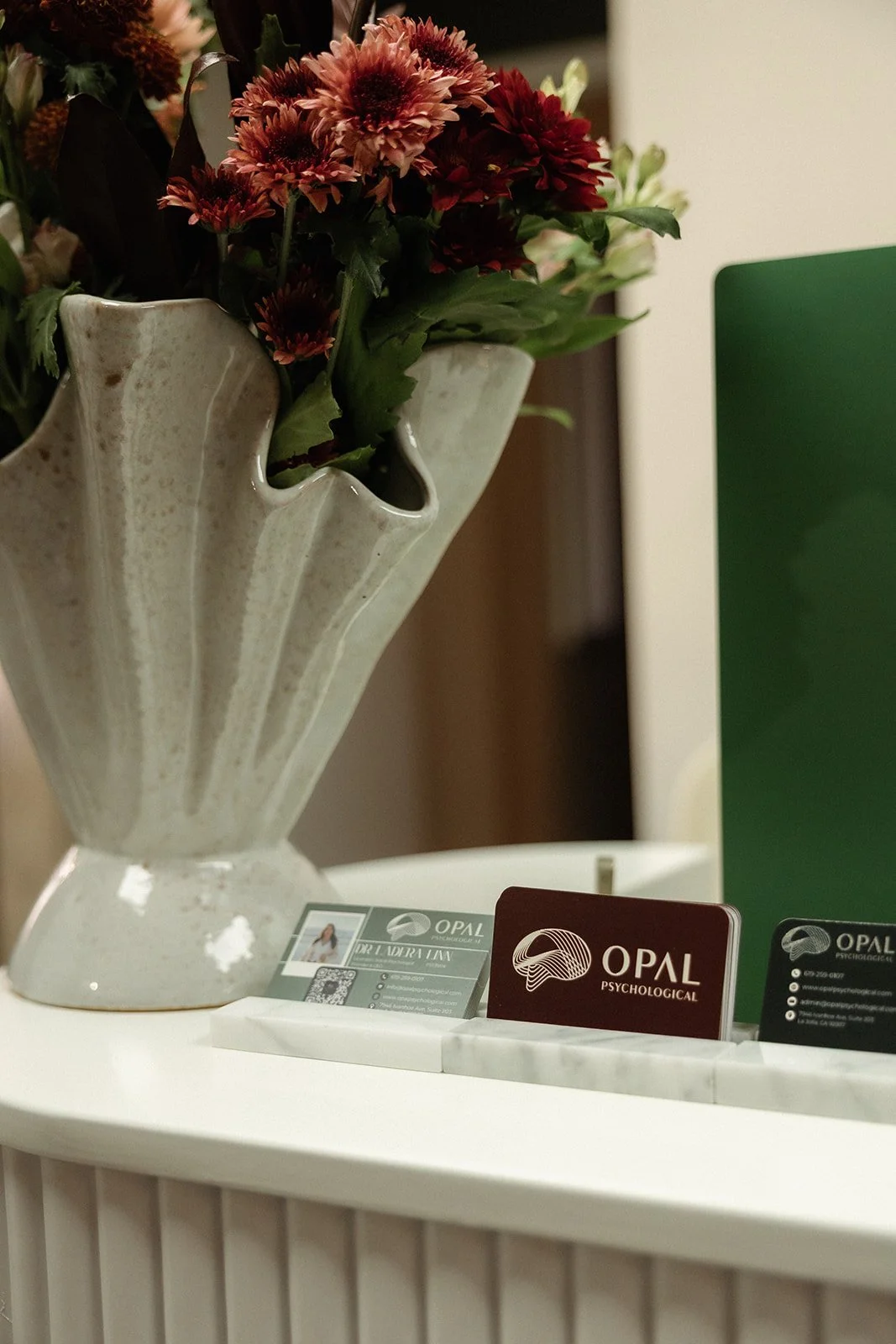
A Welcoming Space to Begin
OPAL Psychological is a boutique psychological practice in La Jolla offering personalized care in a warm, professional setting.
- Personalized psychological care
- Evidence-based treatment
- Professional clinicians
- Individual therapy
- In-person services in La Jolla
- Virtual therapy across California
La Jolla, CA 92037

Explore More Support at OPAL
Better Understanding Starts With a Conversation.
If relationship stress or communication challenges have been weighing on you, individual therapy may offer a place to explore what’s happening and consider different ways forward.
This page is for general information and is not a substitute for professional advice, diagnosis, or treatment. If you are in crisis or need immediate support, call or text 988 (Suicide & Crisis Lifeline), or call 911 in an emergency.